AEO & GEO Industry Report 2026: How AI Search is Reshaping B2B Discoverability (in partnership with GrackerAI)
TL;DR
- The definitive AEO & GEO industry report for 2026. Discover how AI search engines like ChatGPT, Perplexity, and Google AI Overviews are reshaping B2B discoverability and what your team needs to do about it.
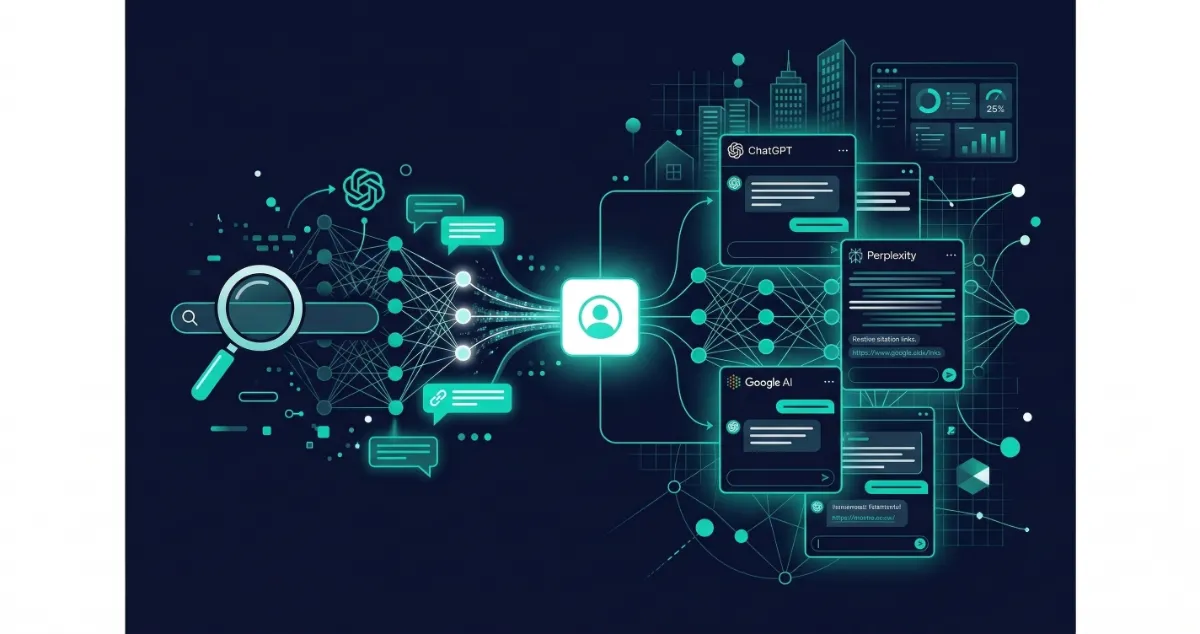
The way buyers discover software has fundamentally changed. For over two decades, the playbook was straightforward: rank on Google, capture the click, convert the visitor. But in 2026, that playbook is broken. Buyers are no longer just searching they are asking. They are typing full questions into ChatGPT, Perplexity, Google AI Overviews, and Claude, and receiving direct, synthesized answers that often never link back to a source. The click is disappearing, and with it, the assumptions that powered an entire generation of B2B marketing.
This is not a theoretical future. It is the reality of right now. Gartner has confirmed that traditional search engine volume has dropped 25% as AI chatbots absorb queries. Around 93% of AI search sessions now end without a single visit to a website. ChatGPT alone commands an 80.49% share of the AI chatbot market. AI-referred sessions have surged 527% year-over-year. And 50% of B2B software buyers now start their journey in an AI chatbot rather than Google a 71% jump in just four months.
For B2B companies especially SaaS the question is no longer whether AI search matters. The question is whether your brand shows up when these AI engines answer the questions your buyers are asking. This report, produced in partnership with GrackerAI, the leading AEO and GEO visibility monitoring platform, presents the data, frameworks, and strategic recommendations B2B teams need to navigate this new reality.
Table of Contents
Defining the New Landscape: AEO, GEO, and the Discoverability Stack
AI Search Engine Profiles: How Each Platform Discovers and Cites
The Role of Monitoring: Why You Cannot Optimize What You Cannot Measure
Executive Summary
The B2B discovery landscape has reached a decisive inflection point what industry analysts are calling "The Great Decoupling." Traditional organic search remains a traffic driver, but a parallel ecosystem powered by AI answer engines is growing at a rate that demands immediate, strategic action. This report identifies seven critical findings:
AI search adoption among B2B buyers has reached critical mass. 94% of B2B buyers now use LLMs during their buying process. 50% start their journey in an AI chatbot rather than Google. One in four prefers AI tools over conventional search engines when evaluating suppliers.
The zero-click reality is more extreme than predicted. 93% of AI search sessions end without a visit to any website. But brands that are cited in AI-generated answers convert at a 14.2% rate 5x higher than traditional search traffic at 2.8%.
Platform fragmentation demands platform-specific strategies. ChatGPT, Perplexity, and Google AI Overviews each favor fundamentally different source types. Only 11% of domains are cited by both ChatGPT and Perplexity. 60% of Google AI Overview citations come from URLs not in the top 20 organic results.
The GEO services market is exploding. Valued at $848 million in 2025, it is projected to reach $33.7 billion by 2034 at a 50.5% CAGR making it one of the fastest-growing segments in all of digital marketing.
AI citations drive measurable, outsized business impact. Companies implementing AEO/GEO strategies report 300% increases in qualified leads within 90 days, 287% ROI, and 54% reduction in customer acquisition costs.
97% of CMOs report positive impact. According to the Conductor State of AEO/GEO survey of 250+ enterprise digital leaders, 97% reported positive marketing funnel impact, and 94% plan to increase investment in 2026.
The buyer's "Day One" shortlist is everything. 95% of winning vendors are already on the buyer's initial shortlist and 63% of these AI-generated lists contain only 2-3 products. If your brand is not cited when a buyer prompts an AI, you have a 5% or lower chance of winning the deal.
Defining the New Landscape: AEO, GEO, and the Discoverability Stack
Before diving into the data, let us establish a shared vocabulary. The industry is coalescing around two complementary disciplines that sit on top of traditional SEO.
Search Engine Optimization (SEO)
The foundational practice of optimizing web content and site architecture to achieve high rankings in the organic results of conventional search engines like Google and Bing. The primary goal is to rank as high as possible to attract clicks and drive traffic. Key metrics include keyword ranking, organic traffic volume, and click-through rate.
SEO has not become irrelevant it remains the infrastructure layer. But it is no longer sufficient on its own.
Answer Engine Optimization (AEO)
AEO (Answer Engine Optimization )is a specialized discipline focused on structuring and creating content so that it is selected as the direct, cited source for factual answers provided by AI platforms Google AI Overviews, voice assistants, and conversational AI responses like ChatGPT and Perplexity.
The core principle of AEO is structural clarity. AI engines need to parse your content, extract a definitive answer, and attribute it with confidence. The goal is to own the answer to be the source the AI quotes, not just a link in a list. Key metrics include AI Visibility Score, citation frequency, and featured snippet ownership.
Generative Engine Optimization (GEO)
GEO (Generative Engine Optimization) is the broader strategic discipline aimed at ethically influencing the training data and Retrieval-Augmented Generation (RAG) indexes of Large Language Models. While AEO focuses on being the direct answer, GEO focuses on being mentioned, cited, or recommended when AI engines synthesize information from multiple sources into narrative responses.
GEO requires a fundamentally different mindset. In a generative context, you are not competing for a position on a results page. You are competing for inclusion in a synthesized narrative. The AI model decides not just which sources to cite, but how to frame the information it presents. Key metrics include Share of Model (SoM), entity citation frequency, and AI mention share.
The Discoverability Stack
Think of SEO, AEO, and GEO as three layers of a single discoverability stack:
Dimension | Traditional SEO | AEO | GEO |
|---|---|---|---|
Output format | Ranked list of links | Direct answer / snippet | AI-generated narrative with citations |
Success metric | Rankings, organic clicks | Featured snippet ownership | Citations, AI mention share |
Content focus | Keywords, backlinks, technical SEO | Question-answer format, structured data | Authoritative definitions, data density |
Query type | Keyword-based | Question-based | Conversational, multi-intent |
User behavior | Click to website | Read answer (may not click) | Read AI answer (may click source) |
Maturity | Mature (25+ years) | Established (5-8 years) | Emerging (2024-2026) |
Companies that invest across all three layers will capture the largest share of buyer attention. Those that optimize only for traditional SEO will find their visibility eroding as AI engines answer more and more of the queries that once drove their traffic.
The Numbers: AI Search Adoption in B2B
The adoption curve for AI-powered search among B2B buyers has been steeper than most predictions anticipated. Here is what the data tells us.
Buyer Behavior Has Shifted - Dramatically
94% of B2B buyers use LLMs during their buying process (6sense, surveyed across 4,510 buyers with $25K+ purchases).
89% of B2B buyers have adopted generative AI as a key information source rising from approximately 0% in January 2024 (Forrester).
50% of B2B software buyers now start their journey in an AI chatbot rather than Google a 71% jump in just four months (G2).
Two-thirds of B2B buyers rely on AI chatbots as much as or more than Google or Bing when comparing vendors.
44% of AI-powered search users say it is their primary and preferred source of insight, topping traditional search at 31% (McKinsey).
Enterprise Teams Are Investing Aggressively
97% of CMOs and digital leaders reported AEO/GEO had a positive impact on the marketing funnel (Conductor, 250+ enterprise leaders surveyed).
94% plan to increase their AEO/GEO investment in 2026.
56% of CMOs made a significant or high investment in AEO/GEO in 2025.
73% of CMOs classify their AEO/GEO programs as advanced or very advanced.
86% of enterprise SEO teams have integrated AI into their workflows, and 82% plan to increase investment.
The Traffic Shift Is Accelerating
AI-referred sessions jumped 527% between January and May 2025.
ChatGPT commands 80.49% of the AI chatbot market share, dominating Perplexity, Copilot, Gemini, Claude, and DeepSeek.
Google's market share dipped to 89.34% in 2026 the first time below 90% since 2015.
Traditional search engine volume has dropped 25% as users shift to AI chatbots (Gartner).
Global Adoption Is Not Uniform
AI search adoption varies dramatically by region. The UAE leads globally with 64% of its working-age population actively using AI, driven by a national AI strategy initiated in 2017 and public trust levels of 67%. Singapore follows at 60.9%. The US sits at 28.3% behind not just tech hubs but also Belgium, the Netherlands, and Spain. For B2B companies, this means the urgency to adapt varies by market, but the direction is universal.
The Zero-Click Reality
The most disruptive consequence of AI search is the evaporation of the click. Traditional search was built on a value exchange a search engine ranks your content, and you receive a visitor. AI search breaks this model entirely.
The Data Is Stark
93% of AI search sessions end without a visit to any website (Semrush).
Over 65% of all searches including traditional now end without a single click.
AI Overviews now appear in 25.11% of Google searches, up from 13.14% in March 2025 (Conductor analysis of 21.9 million queries).
On average, users click only once for every 20 AI search prompts.
Google's own properties now capture nearly 30% of all search clicks (YouTube, Maps, Images), effectively transitioning Google from a traffic partner to a traffic competitor.
The Paradox: Zero Clicks, Higher Value
Here is the critical nuance that changes everything: AI-referred traffic is dramatically more valuable than traditional search traffic.
AI search traffic converts at 14.2% compared to Google's 2.8% that is a 5x higher conversion rate.
Claude referral traffic converts at an even higher 16.8% rate.
AI traffic converts in one-third the number of sessions compared to other traffic sources.
One B2B marketing agency reported a 25x higher conversion rate from AI-referred traffic compared to other channels.
The zero-click world does not mean zero value. It means the value has shifted from traffic volume to citation quality, from click to recommendation, from ranking to being the answer. When an AI engine mentions your product, it functions as a pre-qualified endorsement the buyer arrives already educated, already convinced, and ready to act.
AI Search Engine Profiles: How Each Platform Discovers and Cites
One of the most consequential findings from recent citation analysis is the extent to which different AI platforms favor different sources. Understanding these profiles is essential for any B2B GEO strategy.
Google Gemini / AI Overviews (AIO)
Retrieval method: RAG. Integrates AI-generated summaries directly into search results.
Citation behavior: Appears for 30-40% of commercial queries. Only 8% of users click through when AI Overviews appear. Critically, 60% of citations come from URLs not ranking in the top 20 organic results meaning answer-readiness can override traditional domain authority.
Source preferences: Reddit (21%), YouTube (18.8%), Quora (14.3%), LinkedIn (13%). Relatively low reliance on community platforms overall (7%).
Volatility: Extremely high 59.3% monthly citation change rate. Sources are constantly re-evaluated.
Key insight for B2B: Video content, educational demos, and structured data carry outsized weight. Your Google ranking matters less here than your content's answer-readiness.
OpenAI ChatGPT
Retrieval method: RAG via web browsing. GPTBot does not execute JavaScript it only parses server-rendered HTML.
Citation behavior: Low direct citation rate of 0.59%, but it drives up to 87.4% of all AI referral traffic. High monthly citation change rate of 54.1%.
Source preferences: Wikipedia (47.9%), Reddit (11.3%), Forbes (6.8%), G2 (6.7%). Heavily favors established knowledge bases.
Freshness: Extremely strict. 76.4% of cited pages had been updated within the preceding month. Content older than three months sees a steep decline in citation likelihood.
Key insight for B2B: Wikipedia presence, G2/Capterra profiles, and SSR-delivered content are critical. Refresh content monthly.
Perplexity
Retrieval method: RAG with a focus on direct answers and clear sourcing. PerplexityBot does not execute JavaScript.
Citation behavior: Highest citation rate among platforms at 13.05%. Lower volatility with a 40.5% monthly citation change rate slightly more stable and predictable.
Source preferences: Heavily community-driven over 90% of sources are community platforms. Reddit (46.7%), YouTube (13.9%), Gartner (7%) for B2B topics.
Key insight for B2B: Reddit engagement and community presence are non-negotiable for Perplexity visibility. Analyst report citations (Gartner) carry significant weight.
Microsoft Copilot / Bing Chat
Retrieval method: GPT-4 class models integrated with the Bing search index.
Citation behavior: Visual citations within responses. High monthly citation change rate of 53.4%.
Trend: Increasingly focused on shopping and e-commerce queries. Trending toward "branding flattening" treating websites as data sources and potentially diminishing direct brand attribution.
Key insight for B2B: Ensure product data is structured and available for extraction. Brand attribution may require explicit entity signals.
Anthropic Claude
Retrieval method: ClaudeBot web crawler. Does not execute JavaScript.
Citation behavior: Specific citation frequency not widely benchmarked, but referral traffic converts at the highest rate of 16.8% the most valuable AI traffic source measured.
Key insight for B2B: The highest-converting AI traffic source. Worth monitoring and optimizing for despite lower volume.
The Overlap Problem
Only 11% of domains are cited by both ChatGPT and Perplexity. A single content strategy cannot serve all platforms. B2B teams need platform-aware content programs and monitoring tools that track visibility across each platform independently.
The GEO Market: Size, Growth, and Opportunity
Market Valuation
The GEO services market was valued at $848 million in 2025 and is projected to reach $33.7 billion by 2034, representing a compound annual growth rate of 50.5% making GEO one of the fastest-growing segments in the entire digital marketing landscape. By 2028, $750 billion in US revenue will funnel through AI-powered search (McKinsey).
What Is Driving Growth
Several converging forces are fueling this expansion:
AI search user growth. ChatGPT alone has 800 million weekly active users. Perplexity processes 780 million queries. Google AI Overviews now appear in over 25% of all searches.
Enterprise budget reallocation. 94% of CMOs plan to increase AEO/GEO investment in 2026. The discipline has moved from experimental to essential.
Proven ROI. Companies implementing GEO strategies report 287% ROI within 90 days, 300% increases in qualified leads, and 54% reductions in customer acquisition cost.
Tooling maturation. Platforms like GrackerAI now provide the monitoring infrastructure that makes GEO a measurable, optimizable discipline rather than guesswork.
The First-Mover Advantage Is Real
AI models tend to reinforce existing citation patterns. Brands that establish strong AI citation profiles now before competitors invest will be disproportionately difficult to displace. Companies that properly implement AEO/GEO strategies are seeing 300% increases in qualified leads within just 90 days. The window for early movers is closing.
The B2B Buyer Journey Has Been Rewritten
The B2B buyer journey has undergone a structural transformation. The shortlisting and vendor comparison phase traditionally conducted through vendor websites, review sites, and sales conversations has migrated into AI chatbots.
How Buyers Use AI Now
Buyers use platforms like ChatGPT and Perplexity to perform complex, multi-variable comparisons and generate initial vendor shortlists before a vendor is even aware of their interest. They use sophisticated prompts like: "Which CRM integrates with Snowflake, supports multi-region compliance, and has the best TCO for a 50-person team?" and receive a curated list of 2-3 products.
This means a significant portion of vendor evaluation now happens "off-site," entirely within the AI interface. Buyers are educated "in the engine" before they ever visit your website.
The Day One Shortlist
The data here is decisive:
95% of winning vendors are already on the buyer's "Day One" shortlist up from 85% prior year (6sense, November 2025).
63% of these AI-generated shortlists contain only 2-3 products.
If you are not cited when a buyer prompts "recommend the best [solution] for [use case]," you have a 5% or lower chance of winning the deal.
The Funnel Has Compressed
This AI-driven shortlisting dramatically compresses the traditional sales funnel:
Fewer exploratory website visits buyers are educated within the AI interface.
Higher quality leads when buyers do make contact, they are significantly more informed and have already defined requirements.
Shorter sales cycles the average B2B sales cycle dropped from 11.3 months in 2024 to 10.1 months in 2025.
Earlier engagement the point of first contact with sales moved from 69% to 61% of the way through the journey.
The implication is clear: winning in AI search is not a marketing nice-to-have it is a pipeline imperative.
What Actually Drives AI Citations
Understanding the mechanics of AI citation is essential for any GEO strategy. Based on analysis of citation patterns across major platforms, several factors consistently determine whether a brand appears in AI-generated responses.
1. Entity Authority and Consensus
AI models build internal representations of entities brands, products, people, concepts. The strength of your entity profile directly influences citation frequency. Entity authority is built through:
Consistent brand mentions across authoritative sources
Structured data and schema markup with unique identifiers (
@idin schema)Wikipedia and Wikidata presence
Mentions in industry publications, analyst reports, and review platforms (G2, Capterra, TrustRadius)
Using the
sameAsproperty to link to authoritative profiles
2. Content Structure and Answer-Readiness
AI engines favor content that is comprehensive, well-structured, and unambiguous. Key structural elements include:
Clear headings (H2/H3) phrased as direct questions matching buyer queries
Direct answers in the first 40-60 words under each heading
FAQ sections with precise question-and-answer formatting
Comparison tables with structured data tables get cited at exceptionally high rates (one study showed 45% citation rate for comparison tables within two months)
High "fact density" original data, statistics, and specific benchmarks
3. Source Diversity and Third-Party Validation
Up to 85% of brand mentions in AI answers originate from third-party pages, and nearly 50% from community platforms. Being cited by multiple independent sources dramatically increases AI citation probability:
Third-party review sites (G2, Capterra, TrustRadius)
Community platforms (Reddit, LinkedIn, Quora, Stack Overflow, GitHub)
Industry publications and analyst reports (Gartner, Forrester)
YouTube and podcast content
4. Recency and Freshness
AI models prioritize fresh content. Pages not updated quarterly are 3x more likely to lose citations. For ChatGPT specifically, 76.4% of cited pages had been updated within the preceding month. Regular content refreshes are not optional they are essential for maintaining citation positions.
5. Unlinked Brand Mentions
Unlike traditional SEO where backlinks are the currency of authority, AI engines weigh unlinked brand mentions heavily. A mention of your product in a Reddit thread, a comparison article, or an analyst report even without a hyperlink contributes meaningfully to your AI citation profile.
The AEO Technical Playbook
Implementing a successful AEO strategy requires a robust technical foundation designed for machine readability.
Critical: Server-Side Rendering (SSR)
The single most important technical prerequisite. Major AI crawlers GPTBot (OpenAI), ClaudeBot (Anthropic), and PerplexityBot do not execute client-side JavaScript. Content rendered via Client-Side Rendering (CSR) is often invisible to them, resulting in a 50-80% loss of discoverable data. All product information, pricing, documentation, and structured data must be present in the initial HTML source.
Structured Data Implementation
Comprehensive Schema.org implementation via JSON-LD has been shown to increase AI citation rates by 2.8x. Essential schemas for B2B SaaS include:
WebApplicationorSoftwareApplicationfor the productAggregateOfferandOfferwithUnitPriceSpecificationfor pricing tiersFAQPagefor Q&A contentHowTofor tutorials and guidesPersonandOrganizationto signal E-E-A-T (Experience, Expertise, Authoritativeness, Trustworthiness)
Answer-Ready Content Structure
Every key page should follow the "inverted pyramid" structure:
Question as heading - Use H2/H3 headings phrased as the exact questions your buyers ask
Direct answer first - Concise 40-60 word answer immediately under the heading
Supporting evidence - Bullet points, data, tables, and examples that reinforce the answer
Depth -Comprehensive treatment that positions your content as the definitive source
Technical Health
AI RAG systems have strict timeouts and limited crawl budgets. Page load times under 3 seconds, clean URL structures, and shallow crawl depth are crucial for ensuring AI crawlers can efficiently access and parse your content.
The GEO Strategic Playbook
GEO moves beyond on-page tactics to build a strong, positive consensus about your brand across the web the "walled gardens" that LLMs use for training and RAG retrieval.
Pillar 1: Strategic Data Seeding
Since up to 85% of brand mentions in AI answers originate from third-party pages, and nearly 50% from community platforms, authentic engagement on key platforms is critical:
Reddit: Provide valuable, accurate answers in relevant subreddits. Reddit is the top-cited community source for Perplexity (46.7%) and a significant source for ChatGPT (11.3%).
LinkedIn: Share original insights, engage in industry discussions, build thought leadership.
Quora and Stack Overflow: Answer technical questions with depth and authority.
GitHub: For developer-focused products, active contribution and documentation.
The key word is "authentic." AI models are increasingly sophisticated at detecting promotional content. The goal is to provide genuine value that positions your brand as a trusted authority.
Pillar 2: Original Research and Data Density
Content with novel quantitative data generates 4x more citations than content without it. High-impact content types include:
Proprietary research reports with original data
Industry benchmarks and surveys
Data-driven case studies with specific metrics
Technical comparisons with measurable criteria
This increases the "data density" of your digital footprint, making your content more attractive to LLMs seeking factual, citable information.
Pillar 3: Entity Consensus Building
Manage your brand's identity as a distinct entity in the AI's knowledge graph:
Establish and maintain presence on authoritative sources (Wikipedia, Wikidata)
Use unique identifiers (
@idin Schema.org) for company and productsUse
sameAsproperty to link to authoritative profiles across the webEnsure consistent brand information (name, description, positioning) everywhere
Pillar 4: Multi-Platform Content Distribution
Given platform fragmentation, distribute content where each AI engine looks:
For ChatGPT: Authoritative, encyclopedic content. Wikipedia, G2 profiles, comprehensive guides.
For Perplexity: Reddit engagement, YouTube content, analyst report citations.
For Google AI Overviews: Video content, product demos, structured data markup.
For all platforms: Consistent entity signals, regular freshness updates, SSR-delivered content.
Real Results: B2B SaaS Success Stories
The following case studies demonstrate that AEO/GEO is not theoretical it is delivering measurable business results today.
Vercel (Developer Tools)
Strategy: Shifted from keyword volume to "Concept Ownership." Identified frontier technical concepts with low competition and created definitive, high-density documentation. Ensured all docs were SSR-accessible. Heavily engaged on GitHub and Reddit.
Results:
ChatGPT now drives 10% of all new signups up from less than 1% six months prior
10x growth in AI-driven signups in six months
ChatGPT accounts for 80% of all AI referral traffic
AI search became a primary acquisition channel
Tally (Marketing Tech)
Strategy: Created comprehensive comparison guides ("Tally vs. [Competitor]" and "[Competitor] Alternatives") targeting high-intent evaluation queries common in AI chatbots.
Results:
Grew ARR from $2 million to $3 million in just four months (January-May 2025)
AI platforms drove over 2,000 new users per week
AI platforms became the number one referral source
B2B Marketing Agency (Anonymous)
Strategy: Focused on being cited and recommended by AI engines for high-intent marketing queries.
Results:
Generated $340,000 in new sales pipeline from AI referrals within 90 days
300% increase in qualified leads from AI search platforms
25x higher conversion rate from AI-referred traffic vs. other channels
B2B Project Management SaaS (Anonymous)
Strategy: Implemented a holistic AEO/GEO strategy across content, entity optimization, and monitoring.
Results:
287% ROI within 90 days
54% reduction in Customer Acquisition Cost (CAC)
27% conversion rate from AI traffic to Sales Qualified Leads vs. the 2-5% industry average for traditional organic search
B2B Financing Platform (Fintech)
Strategy: Targeted Google AI Overviews optimization for relevant financial queries.
Results:
315% surge in appearances within Google AI Overviews
300% increase in qualified leads
Approximately 100% increase in overall AI-driven referrals
Workfellow (HR Tech)
Strategy: Employed a hybrid human + AI content model targeting comparative questions and long-tail queries.
Results:
10x increase in new enterprise sales meetings over 12 months
5x increase in Marketing Qualified Leads
MindfulHR (HR Tech)
Strategy: GEO strategy focused on achieving high visibility within AI-generated answers for core queries.
Results:
17% increase in inbound leads within just six weeks
Achieved 60-80% visibility in AI answers for core queries
Measuring What Matters: New KPIs for the AI Era
Traditional SEO metrics keyword rankings, organic traffic volume, click-through rates are becoming insufficient. The AI era demands new KPIs.
Share of Model (SoM)
The most important new metric. SoM is the generative AI era's equivalent to "Share of Voice." It measures how often AI platforms mention, cite, or recommend your brand compared to competitors when answering relevant queries.
Formula: SoM = (Your Brand Mentions / Total Category Mentions) x 100
How to measure: Use a representative sample of 250-500 high-intent queries relevant to your category. Audit across multiple LLMs (ChatGPT, Gemini, Perplexity, Claude) visibility varies significantly between models.
Additional AI-Era KPIs
KPI | What It Measures |
|---|---|
AI Visibility Score | Overall brand presence across AI platforms |
Citation Frequency | How often your content is cited as a source |
AI-Referred Conversions | Leads and revenue from AI referral traffic |
Groundedness Score | Accuracy of AI mentions about your brand |
LLM Perception Drift | Changes in how AI represents your brand over time |
Citation Share by Platform | Visibility breakdown across ChatGPT, Perplexity, Gemini, etc. |
Why Traditional Metrics Still Matter
Traditional metrics are not obsolete they are foundational. But they must be supplemented. A company might maintain strong Google rankings while being completely absent from AI-generated responses. Without the new KPIs, that dangerous blind spot would go undetected.
The Role of Monitoring: Why You Cannot Optimize What You Cannot Measure
In traditional SEO, the discipline matured when rank tracking tools gave marketers visibility into performance. The same inflection point is arriving for GEO.
What AI Visibility Monitoring Looks Like
Modern AI visibility monitoring platforms track your brand's presence across ChatGPT, Perplexity, Claude, Gemini, and Google AI Overviews. They answer questions like:
How often is our brand cited when buyers ask about our category?
Which competitors are mentioned more frequently, and for which queries?
Has our citation share increased or decreased over the past 30, 60, or 90 days?
Which content assets are most frequently cited as sources?
Are there high-value queries where we are completely absent?
Is the AI accurately representing our product, or is there perception drift or hallucination?
GrackerAI: Purpose-Built for This Challenge
GrackerAI has emerged as the leading platform for AI visibility monitoring, specifically designed for B2B SaaS companies. The platform provides:
Real-time citation tracking across ChatGPT, Perplexity, Claude, Gemini, and Google AI Overviews
Competitive benchmarking that shows exactly where competitors are cited and where gaps exist
Content gap analysis that identifies high-value queries where your brand is absent
Automated content recommendations optimized for AI engine consumption
Performance trending to measure the impact of your GEO strategy over time
Perception monitoring to detect hallucinations, brand misrepresentation, and narrative drift
Companies using GrackerAI report up to a 60% or greater improvement in AI visibility within 90 days, with initial improvements visible in as little as four to six weeks.
The Monitoring Imperative
Without monitoring, GEO is guesswork. Given that citation change rates across platforms range from 40% to 59% per month, your AI visibility is constantly shifting. Continuous monitoring is not optional it is the foundation of any serious AEO/GEO program.
Risk Management and Brand Safety
The rise of AI-powered search introduces new categories of risk that B2B companies must actively manage.
Hallucination Liability
AI models can generate factually incorrect information about your products, pricing, or policies. For B2B SaaS, where purchasing decisions involve significant investment and are based on technical accuracy, such misinformation can erode customer confidence and undermine sales pipelines.
The risk is not theoretical. A Canadian tribunal held Air Canada liable for its chatbot's incorrect refund advice, establishing a legal precedent for "hallucination liability." Companies can be held financially and legally responsible for misinformation generated by AI systems even when they did not create the content.
Brand Narrative Distortion
AI engines synthesize information from multiple third-party sources. This means your brand narrative is being constructed outside your control. Without monitoring, competitors or inaccurate sources can shape how AI represents your product.
Shadow AI Risk
B2B buyers increasingly use AI tools without formal organizational procurement "Shadow AI." This means buyers are making purchasing decisions based on AI recommendations that your marketing team may not even know exist, let alone optimize for.
Mitigation Strategy
Implement continuous monitoring using platforms like GrackerAI to track AI mentions, detect hallucinations, and measure perception drift
Establish review gates covering factual accuracy, brand voice, and legal compliance for all content used to inform AI systems
Build rapid correction workflows using feedback loops provided by AI engine providers
Maintain authoritative source content that AI engines can use as ground truth
Monitor competitor AI citations to detect competitive displacement early
The Future: Agentic Search and Beyond
The shift from traditional search to AI-powered answers is only the beginning. The next wave agentic search will be even more transformative.
The Rise of AI Agents
The most significant emerging trend is autonomous AI agents that can execute complex tasks on a user's behalf - booking travel, making purchases, conducting detailed vendor comparisons, and completing transactions without human intervention.
By 2028, 90% of B2B buying is predicted to be intermediated by AI agents, pushing over $15 trillion through AI agent exchanges. By end of 2026, 40% of enterprise applications will integrate task-specific AI agents (up from less than 5% in 2025).
This shifts the optimization goal from simply being cited to becoming a "trusted entity" that an AI agent is authorized to transact with.
WebMCP and Machine-to-Machine Discovery
Emerging technical standards like WebMCP (Web Model Context Protocol) are being developed to facilitate machine-to-machine interaction. These standards will allow websites to expose their capabilities as structured "tools" for AI agents to use enabling direct transactions, API calls, and data exchanges without human browser interaction.
Multimodal Search
Visual search is expanding the zero-click environment. Google Lens handles nearly 20 billion visual queries monthly. Analysis shows that sources featured in AI Overviews are significantly more likely to integrate text, images, and video. Future AEO/GEO strategies must optimize not just text but also images, videos with transcripts, and structured data.
The New Operating Model
Forward-thinking B2B SaaS companies are creating dedicated AEO/GEO Lead roles evolving from or replacing the traditional SEO Lead. This role owns the strategic roadmap, defines new KPIs, and ensures cross-functional alignment between content, technical SEO, product, data, and legal teams. The core objective: make the company the authoritative, cited source in AI-generated answers for high-intent buyer queries.
Conclusion and Recommendations
The shift from search to AI-powered answers is the most significant change in B2B discoverability since Google itself became dominant. Companies that treat this as a passing trend will find themselves increasingly invisible to the buyers who matter most. The companies that invest now will secure a compounding advantage that becomes harder for competitors to overcome with each passing quarter.
Immediate Actions for B2B Leaders
Audit your AI visibility today. Use a platform like GrackerAI to understand where you stand across ChatGPT, Perplexity, Google AI Overviews, and Claude. If you are not on the "Day One" shortlist, you have a 5% or lower chance of winning the deal.
Fix your technical foundation. If your content is client-side rendered, AI crawlers cannot see it. Implement SSR/SSG and comprehensive Schema.org markup immediately this alone can increase citation rates by 2.8x.
Allocate dedicated GEO resources. 94% of CMOs are increasing investment in 2026. This is not a side project for your existing SEO team. It requires dedicated strategy, content, and measurement.
Implement continuous monitoring. Citation change rates of 40-59% per month mean your AI visibility is constantly shifting. Without real-time monitoring, you are flying blind.
Build multi-platform presence. 85% of AI brand mentions come from third-party pages. Invest in Reddit engagement, G2 profiles, YouTube content, and analyst relationships not just your own website.
Create answer-ready content. Structure content with question-based headings, direct 40-60 word answers, comparison tables, and high data density. Content with original quantitative data generates 4x more citations.
Move now. AI models reinforce existing citation patterns. Brands that establish visibility early will be disproportionately difficult to displace. The first-mover advantage is real, measurable, and compounding.
About This Report
This report was produced in partnership between LynkDog and GrackerAI.
LynkDog is the leading backlink monitoring and protection platform for SEO agencies and freelancers, providing real-time alerts, automated reporting, and proactive link protection.
GrackerAI is the leading AEO and GEO visibility monitoring platform for B2B SaaS, providing real-time citation tracking, competitive benchmarking, and AI-optimized content recommendations across ChatGPT, Perplexity, Claude, Gemini, and Google AI Overviews.
For questions about this report or to learn more about monitoring your AI search visibility, visit gracker.ai.