SOPs for Scale: How to Manage Link Building for 50+ Clients
TL;DR
- The difference between a $500K agency and a $5M agency isn't talent — it's process. Here are the operational systems that let you scale link building without losing quality or your mind.
There's a moment in every agency's life that feels like hitting a wall at full speed.
At 10 clients, the founder is doing everything. Prospecting, outreach, client calls, invoicing. It works because one person can hold the entire system in their head. There are no processes because there doesn't need to be — the process is the person.
At 25 clients, it starts to crack. Things slip through. A link placement goes unreported. An outreach thread goes cold because nobody followed up. The founder hires people to help, but they can't replicate the founder's intuition because it was never documented.
At 50 clients, the wheels come off. The spreadsheets are a graveyard of outdated data. Team members are stepping on each other's toes, pitching the same publications, or worse, pitching different publications contradictory content for the same client. Quality drops. Client satisfaction drops. Revenue plateaus even as headcount grows.
This is the Operational Valley of Death, and the only way through it is systematization.
Here's how the agencies that make it to the other side actually do it.
Principle 1: Separate the Roles
The single biggest mistake scaling agencies make is hiring "SEO Generalists" — people who prospect, outreach, write content, manage clients, and check links. This breaks at scale because:
Context switching kills productivity. Jumping from a relationship-building email to a data audit to a client call costs 20-30 minutes of refocusing time per switch.
You can't measure what you can't isolate. If one person does everything, you can't tell if your bottleneck is prospecting, content, or outreach.
The Four Seats of a Scaled Link Building Operation:
The Prospector — Owns the target list. Their job is to identify high-quality, topically relevant link opportunities. They live in Ahrefs, Semrush, and Google SERPs. Their output is a vetted list of targets with contact information, domain metrics, and relevance scores.
The Outreach Specialist — Owns the relationship. They write the pitches, manage the follow-up cadence, and negotiate placements. Their performance is measured by response rate and placement rate, not volume.
The Content Producer — Owns the assets. When a placement requires a guest post, infographic, or data piece, this person creates it. They work from briefs produced by the Outreach Specialist in collaboration with the client's Account Manager.
The Account Guardian — Owns the portfolio. This person doesn't build new links — they protect existing ones and manage the client relationship. They monitor link health, produce reports, handle re-engagement when links break, and run the monthly strategy call.
At smaller scale, one person might wear two of these hats. But the roles should always be distinct, even if the people aren't. This way, when you do hire, you know exactly what seat you're filling.
Principle 2: The "Single Source of Truth" Rule
At 50+ clients, you're managing somewhere between 5,000 and 50,000 active backlinks. If this data is spread across spreadsheets, Trello boards, Slack threads, and email inboxes, you are already drowning.
You need a centralized system where:
Every link has a record — URL, anchor text, target page, acquisition date, current status.
Every status change is logged — When did the link go live? When did it last pass verification? When (if ever) did it break?
Every client has a dashboard — One view that shows their complete portfolio health at a glance.
The technology matters less than the discipline. Whether you use LynkDog, a custom Airtable build, or a homegrown database, the rule is the same: if it's not in the system, it doesn't exist.
This eliminates the most dangerous phrase in agency operations: "I think that link is still live."
Principle 3: The Quality Gate
Speed kills quality. And at scale, the pressure to "ship links" often overrides the judgment to vet them properly.
Institute a two-person quality gate at two critical moments:
Gate 1: Pre-Outreach
Before a Prospector's target list goes to the Outreach Specialist, a Senior SEO reviews it. They're looking for:
PBN signals: Thin content, no real traffic, excessive outbound links.
Relevance: Is this site actually in the client's niche, or is it a "general lifestyle" blog that will accept anything?
Risk: Has this site been penalized before? Is the domain history clean?
Gate 2: Post-Placement
Before a link goes into the client report, a Senior verifies:
Is the link live and correctly attributed? (Correct anchor text, dofollow, correct target URL.)
Is the surrounding content quality acceptable? A link buried in a 200-word AI-generated filler post is a liability, not an asset.
Does the page actually receive traffic? A link on a page that gets zero visits passes no practical value.
These gates add 15 minutes per link to your workflow. They save you from the client call where someone asks, "Why did you build a link on a site that looks like spam?"
Principle 4: Monitoring as Infrastructure, Not a Task
At scale, monitoring isn't something an intern does on a Friday afternoon. It's infrastructure that runs continuously, like a security system.
Here's why this matters operationally:
Without monitoring: Your Account Guardian spends 8+ hours per week manually checking a spreadsheet of links. They skip half of them because it's tedious. When a client asks "are all my links still live?" the honest answer is "I don't know."
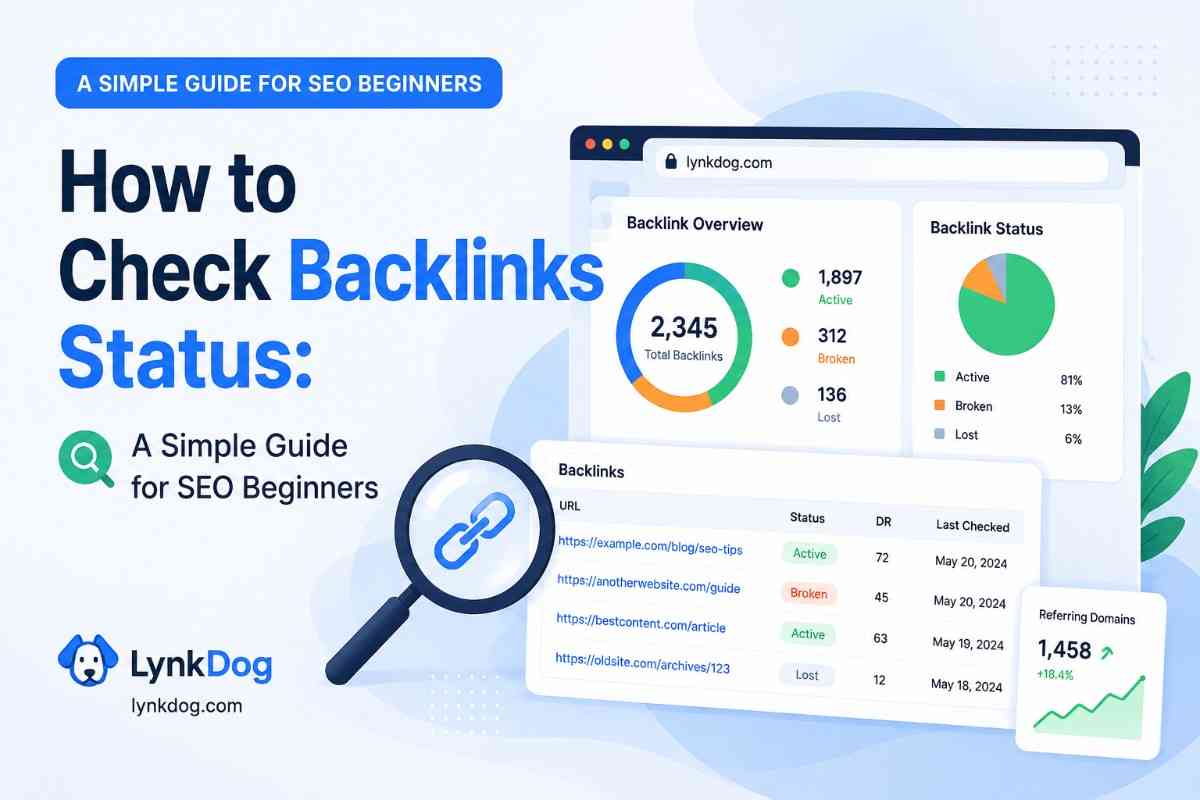
With monitoring: Your Account Guardian spends zero hours checking links. An automated system (like LynkDog) pings every URL daily and sends alerts only when something changes. The Guardian's job shifts from checking to acting — responding to alerts, coordinating reclamation, and reporting on portfolio health.
This is the shift from active monitoring (expensive, error-prone, unscalable) to passive monitoring (cheap, comprehensive, automatic). It's the difference between paying a guard to walk the perimeter every hour and installing a motion sensor.
Principle 5: The Client Communication Cadence
At scale, the danger isn't over-communicating — it's under-communicating. Silence breeds anxiety, and anxious clients leave.
The Cadence:
Real-Time: Automated alerts to the Account Guardian when link status changes. Client never sees these directly — they see the outcome ("We caught and fixed an issue").
Weekly (Optional): A "Quick Win" email when there's something worth celebrating. A new high-DR placement, a successful link reclamation, a ranking jump. Two sentences. No deck. Just a signal that says, "We're working and winning."
Monthly: The full report (see our guide on The Perfect Monthly Report). This is the formal touchpoint where you tell the story of the month.
Quarterly: The Business Review. Zoom out. Look at portfolio growth over 90 days. Discuss strategy for the next quarter. Align with the client's upcoming product launches or campaigns.
This cadence scales because the Weekly and Real-Time touchpoints are lightweight. They take 2 minutes to send but generate disproportionate trust.
The Uncomfortable Math
Here's why all of this matters financially.
An agency at 50 clients charging an average of $3,000/month retainer is doing $150K/month, or $1.8M/year. If your churn rate is 5% per month (industry average for agencies without strong processes), you lose 2–3 clients every month and need to replace them just to stay flat.
Drop that churn rate to 2% through better communication, reporting, and proactive monitoring, and you retain 18 more clients per year. At $3,000/month, that's $648,000 in preserved revenue — without acquiring a single new client.
Process isn't overhead. Process is profit.
The Bottom Line
Scaling a link building agency isn't about working harder or hiring faster. It's about building a machine with clear roles, reliable data, quality controls, and automated infrastructure.
The agencies that cross the 50-client threshold and keep growing are the ones that operate like systems, not like individuals.
Let LynkDog be the monitoring layer of your system. Try it free.